

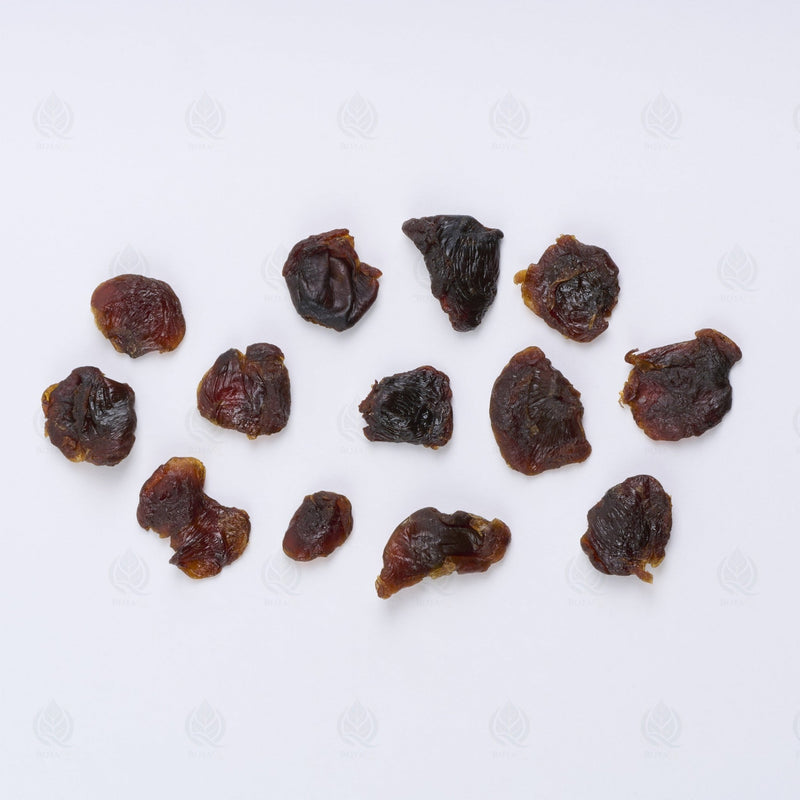
Smoked mume plum


Smoked Plum / Mume Fruit
乌梅Wu Mei·Prune Mume fumée
Mume Fructus
- Specialist suppliers based in France
- Dispatched within 24/48h, packed to order
- Kept away from light and moisture

Prunier mume 梅
Prunus mume
Wu Qijun, Zhiwu mingshi tukao, 1848
According to the classical texts
敛肺涩肠 生津安蛔
Pinyin
Lian Fei Se Chang · Sheng Jin An Hui
Overview
The unripe fruit of Prunus mume (the Japanese apricot, the “ume” of the famous Japanese umeboshi), picked green and smoked, then dried until it becomes that characteristic shrivelled brownish-black plum.
The traditional smoking concentrates the organic acids and gives the plum its uniquely intense sour-smoky savour.
A plant-food of thousand-year-old tradition in Chinese cookery (sauces, marinades) and orthodox in the pharmacopoeia.
To be distinguished from Mei Gui (rose), despite the shared root in the name.
Traditional uses
The reference astringent herb for gathering in scattered Liquids (Jin Ye) (a descending movement that scatters over time, a surface that no longer holds for want of fullness).
Also traditionally used to engender the Liquids (Jin Ye) when deficient no longer feeds them, and to quiet constitutions where the Qi of scatters to excess. A powerful yet approachable astringent action.
Preparation and traditional-use quantity
- Decoction: 6 to 8 g, simmer for 25 minutes
- Carbonised form (Wu Mei Tan): a traditional, more astringent version
- Traditional cooking: Japanese umeboshi (salted fermented plum), Chinese sauces made with Wu Mei
- Wu Mei Tang: a classic blend of Zhang Zhongjing
Precautions
Not recommended for young children. Do not exceed the quantity of use indicated.
To be avoided in cases of an acute attack on the surface not yet resolved or of fullness from inner accumulation (an astringent herb holds back what ought to be let go).
To be used with care by constitutions of settled heat.
In the same family


Red jujube (Chinese date)
大枣 · Da Zao
3,17 €


Aged mandarin peel
陈皮 · Chen Pi
From 6,50 €


Chinese hawthorn fruits
山楂 · Shan Zha
5,67 €


Dried longan
龙眼肉 · Long Yan Rou
7,50 €