

Magnolia officinalis bark


Magnolia Bark
厚朴Hou Po·Écorce de Magnolia officinalis
Magnoliae Officinalis Cortex
- Specialist suppliers based in France
- Dispatched within 24/48h, packed to order
- Kept away from light and moisture

Magnolia officinal 厚朴
Magnolia officinalis
Wu Qijun, Zhiwu mingshi tukao, 1848
According to the classical texts
燥湿消痰 下气除满
Pinyin
Zao Shi Xiao Tan · Xia Qi Chu Man
Overview
The bark of Magnolia officinalis, the pharmacopoeia magnolia, grown specifically for the pharmacopoeia in Sichuan and Hubei.
Taken with care from specimens of 15 to 20 years (Hou Po means “thick bark”), it is steamed, then dried and rolled into “cigars” that show at the cut a characteristic purplish interior.
Its thick, fibrous bark gives off a warm balsamic scent and a distinctive bitter-pungent taste.
Not to be confused with Xin Yi Hua (the flower buds of magnolia), which usage reads differently.
Traditional uses
The reference herb for carrying down and moving the Qi that stagnates in the median sphere and in the Phase, particularly when that stagnation turns heavy and cumbersome.
Traditionally used for constitutions where the Qi of Wood knots into stagnation and struggles to descend, and for transforming the thick Phlegm that clogs.
Preparation and traditional-use quantity
- Decoction: 3 to 10 g, simmer for 25 minutes
- Ban Xia Hou Po Tang: a classic blend for the sensation of a “ball in the throat” bound to stagnation
- Ginger-prepared form (Jiang Hou Po): the traditional version, which reduces the acridity
- Xin Yi Hua distinction: Hou Po (the bark) carries downward, Xin Yi Hua (the flower) carries upward and opens the nose
Precautions
Not recommended for women who are pregnant.
To be used in moderation in cases of deficient with dryness. Ask a practitioner for advice.
In the same family


Aged mandarin peel
陈皮 · Chen Pi
From 6,50 €

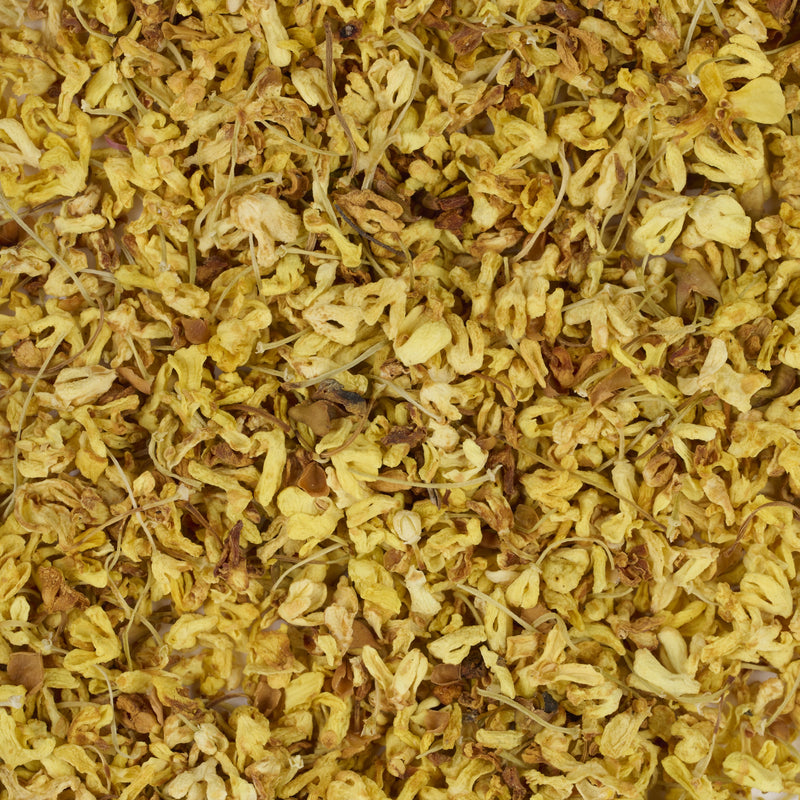

Osmanthus flowers (Sweet olive)
桂花 · Gui Hua
7,50 €