

Chinese cinnamon twigs


Cinnamon Twig
桂枝Gui Zhi·Rameaux de Cannelle de Chine
Cinnamomi Ramulus
- Specialist suppliers based in France
- Dispatched within 24/48h, packed to order
- Kept away from light and moisture

Cannelier de Chine 桂
Cinnamomum cassia
Wu Qijun, Zhiwu mingshi tukao, 1848
According to the classical texts
发汗解肌 温通经脉 助阳化气
Pinyin
Fa Han Jie Ji · Wen Tong Jing Mai · Zhu Yang Hua Qi
Overview
The young twigs of Cinnamomum cassia, the Chinese cinnamon tree, to be strictly distinguished from Rou Gui (the thick bark of the trunk of the same plant).
Gui Zhi is the young branches, the wood still tender and the bark fine, harvested in spring.
Cut into oblique sections of about 3 cm, sun-dried, they come as pale brown cylinders with a cinnamon aroma subtler and fresher than that of Rou Gui.
A central plant in the Shang Han Lun tradition of Zhang Zhongjing.
Traditional uses
The reference herb for releasing the surface of the body in light Wind-Cold, for drawing the Ying and the Wei into harmony (the feeding interior and the guarding exterior), and for warming the meridians when cold hampers them.
Distinct from Rou Gui, which warms the depths: Gui Zhi works at the surface and sets things moving.
The pivot herb of Gui Zhi Tang, the “first blend of the Shang Han Lun”.
Preparation and traditional-use quantity
- Decoction: 3 to 5 g, simmer for 20 minutes
- Gui Zhi Tang: “decoction of Gui Zhi” with Bai Shao, Gan Cao, Sheng Jiang and Da Zao (the first blend of the Shang Han Lun)
- The crucial distinction from Rou Gui: Gui Zhi (the twigs): releases the surface, warms the channels; Rou Gui (the bark): warms the depths, the Ming Men, never to be confused
Precautions
Naturally contains coumarin. Not recommended for children, adolescents, or women who are pregnant or breastfeeding. Do not exceed the quantity of use indicated.
To be avoided in cases of settled heat, of deficient with empty heat, or of active bleeding.
In the same family


Fermented soybeans
淡豆豉 · Dan Dou Chi
5,83 €

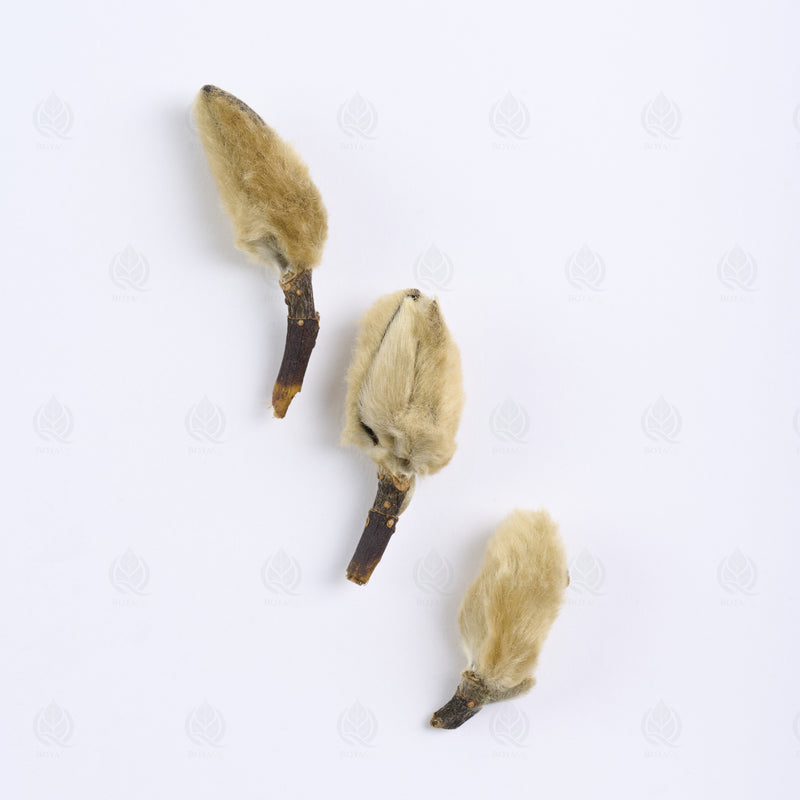

Magnolia buds
辛夷花 · Xin Yi Hua
5,83 €