Where it settles, it ends up covering everything.
Banks, fences, dead trees: the kudzu vine drapes the landscape in a coat of leaves, with a patience that verges on stubbornness.
At the heart of summer, when the heat peaks, it triumphs.
Few plants tell so well the exuberance of the great Chinese summers; and few, beneath that luxuriance, hide such a treasury of traditions.
A vine that devours the horizon
Kudzu (Pueraria montana, variety lobata) belongs to the great legume family; a cousin, then, of the bean and the pea.
Born in East Asia, it climbs, creeps and twines with a force that has become legendary: in full season its stems can gain several tens of centimeters a day, clothing everything they meet in broad three-lobed leaves.
At the end of summer, the vine covers itself in clusters of purple flowers with a sweet scent, recalling grapes.
Exported to the United States at the end of the nineteenth century to hold the soil, the plant proved so conquering there that it was nicknamed “the vine that ate the South”. In China it is not seen that way: there it has always been a familiar.
The root and its starch
Beneath that aerial luxuriance hides the centerpiece: an enormous tuberous root, which plunges deep and can weigh, on old stocks, several tens of kilos.
It is 葛根 gé gēn, literally “the root (根 gēn) of the gé (葛)”.
Dried and then cut into pale woody slices, it is an ancient ingredient of Chinese cooking and culture.
From this root a precious starch is also drawn.
Washed, ground, decanted, the pulp releases a starch of snowy whiteness; the kuzu of the Japanese, the gé fěn (葛粉) of the Chinese.
Heated in water, it passes from milky white to translucent and takes on a silky, quivering, incomparable texture.
The pastry cooks of Asia make from it fresh noodles (kuzukiri), jellies and melting sweets (kuzumochi); cooks use it as a thickener, finer and glossier than cornstarch.
A thread that runs through history
Kudzu has kept China company from very far back.
Long before it was a root of the kitchen, the 葛 (gé) was a fiber plant: from its stems, as early as high antiquity, a textile was drawn, the 葛布 (gé bù), the “cloth of 葛 (gé)”, from which light and breathable summer clothes were made; a rustic luxury mentioned as far back as the Classic of Poetry, the oldest Chinese poetic collection.
Clothing, food, image of an untamable nature: few plants weave so continuous a bond between people and the Chinese earth.
The tradition readily links it, by its season, to the heart of summer, when the vine triumphs and the heat reaches its peak.
That is why it finds its place here, at the breath of the End of Heat: the root of the great summers, which the late season carries to full ripeness.
Worth discovering
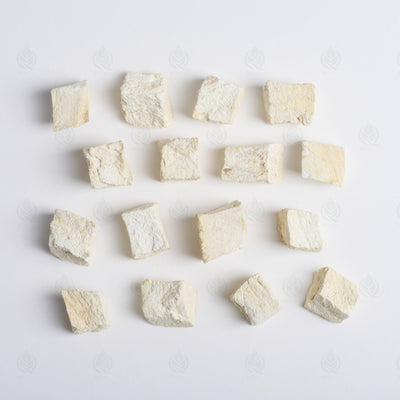
The Kudzu root - 葛根 (Ge Gen) offered by BotaQi comes as dried slices and cubes, faithful to traditional usage.
It can be left to steep at length in trembling water, for a clear and sweet drink, or simmered in a late-season broth. Ground to a fine powder, it coats soups and desserts with a translucent veil, in the manner of Japanese kuzu.
A root to be tamed slowly, for the pleasure of its texture and the thread of history it unwinds.
Towards the breaths of autumn
With kudzu the season of Earth comes to a close, and with it BotaQi’s long summer.
From September on, the year will tip into Metal: the dew will whiten the mornings, the air will turn dry and clear, and other plants; more autumnal, will come in their turn to take the light.
The vine, for its part, will have drawn its sap back deep into the earth, until the next great summer.