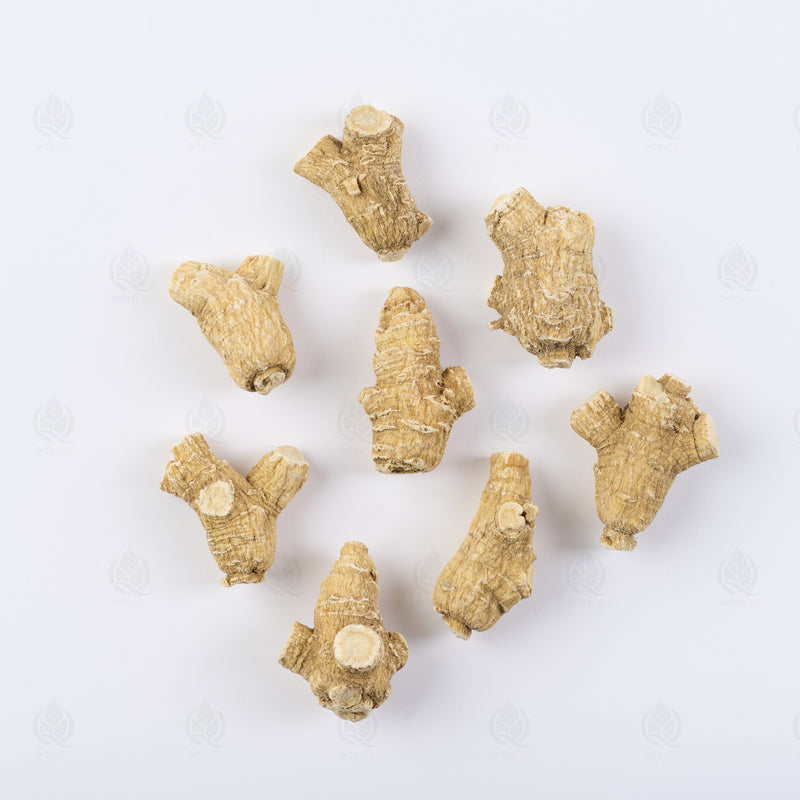
Liquorice (raw) - 甘草 (Gan Cao)

Licorice Root
甘草
Gan Cao·Réglisse (crue)
Glycyrrhizae Radix
- Traced and verified origin
- Dispatched within 24/48h, packed to order
- Kept away from light and moisture
According to the classical texts
补脾益气 清热解毒 祛痰止咳 缓急止痛 调和诸药
Pinyin
Bu Pi Yi Qi · Qing Re Jie Du · Qu Tan Zhi Ke · Huan Ji Zhi Tong · Tiao He Zhu Yao
Overview
The root of Chinese liquorice (Glycyrrhiza uralensis), to be distinguished from European liquorice (Glycyrrhiza glabra), though the uses are close.
Lifted in autumn after three to four years of cultivation in the arid regions of northern China and Mongolia, its long, golden-yellow taproot is cut into rounds.
Its intensely sweet savour — some fifty times that of sugar — makes it one of the most recognisable plants of all.
Present in the majority of the classical blends — it is the “herb of the middle”, the one that brings all the others into accord.
Traditional uses
The herb that draws a blend together above all others — nicknamed “the great marshal of the herbs” by the ancients.
Traditionally used to soften the roughness of the other herbs in a blend, to neutralise certain toxicities, to supplement the median sphere gently, to steady the breath, and to calm tensions or sudden starts.
Present in more than 75% of the classical blends.
Preparation and traditional-use quantity
- Decoction: 2 to 10 g (rarely more within a blend, apart from specific uses)
- Raw form (Sheng Gan Cao): favours the clearing and tempering turn
- Distinction from Zhi Gan Cao: the honey-prepared form makes the supplementing of the Qi more pronounced
- Present in Si Jun Zi Tang: and in the great majority of orthodox blends
Precautions
To be avoided in cases of marked Dampness, of fullness, and when taking medication that affects mineral levels or blood pressure.
Classical incompatibilities with Hai Zao, Da Ji, Yuan Hua, Gan Sui.