At dawn, the grass no longer dries as quickly.
The dew lingers, denser, colder under the fingertip, and one understands, even before looking at the calendar, that something has tipped over.
From 8 to 22 October, the Chinese solar calendar crosses 寒露 (Hánlù), the “Cold Dew”, seventeenth of the year’s twenty-four breaths.
Its name tells the exact nuance of the season: September’s dew was white; October’s turns cold.
A breath of Metal, all withdrawal
Hánlù still belongs to the Metal Phase (金 Jīn), the one tradition associates with autumn, with dry clarity and with the gesture of sorting.
After the equinox, the light has passed the midpoint of its descent: the days shorten for good, the mornings turn sharp, and the air loses that mild warmth still lingering in early October.
The almanacs sum up the breath in a single sentence: the dew turns cold; one draws in, one covers up.
They also recorded its signs in the sky: the wild geese head south, and the chrysanthemum, last to bloom, opens its yellow corollas.
Nothing spectacular: Metal never announces itself with fanfare, but through a clean tightening, that of a season putting away its last warmth.
Covering up, drawing in
“Show your bare ankle no more”: the country saying the almanacs gladly repeat at Hánlù is first a matter of common sense and of the art of living.
Out come the thicker layers; we shield the nape of the neck and the feet from the cool draft, and button the collar in the morning, even if it means opening it at noon.
The wisdom of the breaths is never complicated: it watches the sky and adjusts the clothing.
At Hánlù, it simply invites us to go along with the movement of the year: to gather ourselves inward, like the sap that sinks back down the branches, and to leave the expansiveness of summer behind.
The return of the warm aromatics
At the table, the cooling can be read just as clearly.
The clear, cool infusions of summer no longer have their place; back come the flavors that call to mind the warmth of the hearth: the pungent, the fragrant, the woody.
Classical dietetics places late autumn among the moments when one gladly returns to aromatics: a sliver of fragrant bark in simmering water, a few shards of dried ginger in an evening broth.
Simple seasonal gestures, the ones that make a kitchen smell of October.
And the gesture matters as much as the cup: taking the time to let it steep, holding the bowl in both hands, listening outside to the first real coolness of the year.
To discover
Three aromatics that classical dietetics readily associates with late autumn, waiting for you at the counter:
- Chinese cinnamon bark - 肉桂 (Rou Gui): the fragrant bark of the Chinese cassia tree, warm and woody, which classical dietetics places among the warm flavors of the cold season; a single sliver is enough to perfume simmering water.
- Dried ginger - 干姜 (Gan Jiang): ginger once dried, more concentrated and sharper on the nose than fresh, a companion to autumn broths and teas in Chinese cooking.
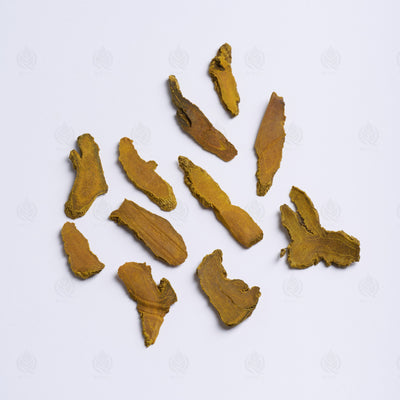
- Turmeric - 姜黄 (Jiang Huang): the golden rhizome with an earthy scent, both pungent and slightly bitter, which classical dietetics likewise places among the warm flavors; a pinch is enough to turn simmering water golden.
Hánlù is only a threshold.
In a few days, the dew will have hardened into frost, and the last breath of autumn, Frost’s Descent, will gently close the season of Metal. Until then, there are these silvery mornings to savor, collar turned up, a warm cup between your hands.