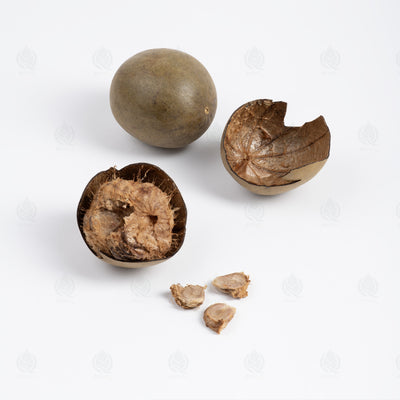
Take it in your hand: a small brown sphere, round as a walnut, surprisingly light, that rustles softly when you shake it.
Nothing in its appearance hints at what it hides: one of the most intense sweetnesses of the plant world.
This is monk fruit, 罗汉果 Luó Hàn Guǒ, the quiet glory of the hills of southern China.
A fruit of the Guangxi hills
The luó hàn guǒ is the fruit of a climbing vine of the cucurbit family, cousin to the squash and the cucumber, which botanists call Siraitia grosvenorii.
It grows in the misty hills of Guangxi and northern Guangdong, particularly around Guilin and the Yongfu district, where the humid climate and the karst landscape suit it.
Picked still green at the end of summer and in autumn, it is then slowly dried, traditionally over a low fire, which browns its shell, lightens it and concentrates its flesh: hence the hollow, light sphere found on our shelves.
Its thin, almost brittle shell protects a fibrous flesh and flat seeds: it is the shell, once broken, that releases the aroma into the hot water.
Look for one that is round, smooth, of a deep and even brown, the sign of a fruit that is ripe and well dried.
The fruit of the monks
Its name tells a story.
Luó hàn (罗汉) refers to the arhats, those sages of Buddhism who have reached awakening; guǒ (果) is the fruit.
“Fruit of the arhats”, then, or fruit of the monks, for tradition tells that monks of the Guangxi mountains were, several centuries ago, the first to grow it and make it known.
The Yao people of these mountains have long prepared it as a drink.
From this scholarly and monastic lineage, the fruit keeps a peaceful aura: it is readily associated with restraint, with slowness, with the simple gestures of tradition.
A sweetness that does not come from the sugar bowl
The signature of luó hàn guǒ is its sweetness: round, deep, almost caramelized, it comes from nothing added but from the very flesh of the dried fruit.
Simply break one, shell and all, let it simmer gently for ten minutes or so in hot water, and you have an amber infusion, naturally mellow, drunk hot or warm, on its own or paired with other plants.
In southern cooking it is also added to long-simmered broths, where its sweetness rounds out the flavors.
Enthusiasts like to pair it with a few dried flowers or a thin slice of ginger, which answer its roundness with a livelier note.
One fruit, a pan of water: simplicity itself.
The companion of the tables of the South
In southern China, monk fruit is a familiar presence in kitchens and on market stalls.
It turns up in the great Cantonese soups simmered for hours on end (老火汤 lǎohuǒ tāng), where it lends its sweetness as a base note without ever dominating; it is readily paired with other dried sweet things, with dates, with flowers.
The markets of Guangxi offer whole baskets of it in autumn, just as the harvest comes down from the hills.
It is an everyday ingredient as much as a small seasonal treasure: within reach, generous, and so concentrated that a single fruit scents a large pan.
Sweetness, here, is for sharing.
Worth discovering
Monk fruit - 罗汉果 (Luo Han Guo) lends itself to every autumn infusion.
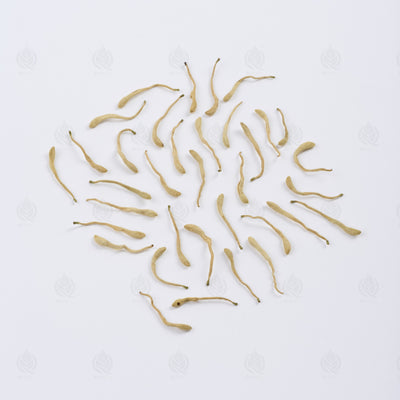
It pairs readily with Japanese honeysuckle - 金银花 (Jin Yin Hua) and Honey-prepared liquorice - 炙甘草 (Zhi Gan Cao): three flavors that answer one another in the same cup.
The honeysuckle flower, called “gold and silver”, brings a fresh, floral note.
The honeyed licorice adds an age-old roundness, sweet without being heavy.
Together they make an amber, floral infusion, of a sweetness that needs neither sugar nor artifice.
Break the fruit, toss in a pinch of flowers and a piece of honeyed root.
Let it simmer gently, then taste a sweetness that has crossed the centuries, from the hills of Guangxi to your cup, with no other secret than time and the low fire of drying.
With it ends our crossing of September: Metal, the dew, the equinox, sweetness.
Soon October will lay an even colder dew upon the mornings, and autumn, drawing in, will deepen.
Nuwa will be delighted to guide you there, breath after breath.