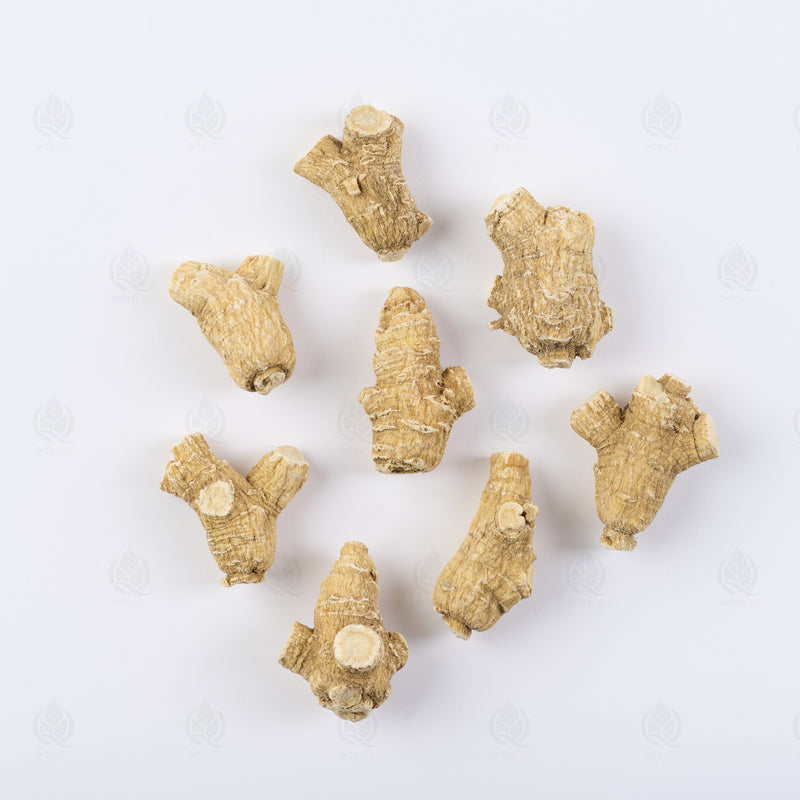
Ficus roots (Downy five fingers) - 五指毛桃 (Wu Zhi Mao Tao)

Hairy Fig Root
五指毛桃
Wu Zhi Mao Tao·Racines de Ficus (Cinq doigts pelucheux)
Fici Hirtae Radix
- Traced and verified origin
- Dispatched within 24/48h, packed to order
- Kept away from light and moisture
According to the classical texts
健脾化湿 行气活血 舒筋活络
Pinyin
Jian Pi Hua Shi · Xing Qi Huo Xue · Shu Jin Huo Luo
Overview
The roots of Ficus hirta, a plant of the Cantonese folk tradition whose leaves, cut into five downy lobes, gave it the poetic name of “five downy fingers”.
Lifted in autumn or in winter in the hot, damp regions of southern China, dried in cream-white slices that give off a very characteristic milky smell (recalling fresh coconut or milk).
Much used in the sustaining cookery of Guangdong (Tang Shui Bao) and in the folk pharmacopoeia of the south.
Traditional uses
A flagship herb of the popular Cantonese pharmacopoeia, of the mild register attached to constitutions of deficient Qi where Dampness is present.
Traditionally used as a mild supplementing material that does not warm too much (an asset in the hot, damp climate of the south) and does not weigh things down.
Often used in the family soups of Guangdong and Hong Kong.
Preparation and traditional-use quantity
- Supplementing soups (Tang Shui Bao): 30 to 60 g (high quantities are possible, the herb being very mild) in a soup simmered for 2 hours with meat, ideal in Cantonese family cooking
- Decoction: 15 to 30 g, simmer for 30 minutes
- A Cantonese particularity: a herb little present in the classic repertoires of the north, but unavoidable in the south
Precautions
To be used in moderation in cases of very marked stagnation (its sweetness can feed constitutions of thick Dampness).