

Achyranthes root


Achyranthes Root (Huai)
怀牛膝Huai Niu Xi·Racine d’Achyranthes
Achyranthis Bidentatae Radix
- Specialist suppliers based in France
- Dispatched within 24/48h, packed to order
- Kept away from light and moisture

Achyranthe 牛膝
Achyranthes bidentata
Wu Qijun, Zhiwu mingshi tukao, 1848
According to the classical texts
活血通经 补肝肾 强筋骨 引血下行
Pinyin
Huo Xue Tong Jing · Bu Gan Shen · Qiang Jin Gu · Yin Xue Xia Xing
Overview
The root of Achyranthes bidentata, grown in Henan (the historic Huaiqing region, hence the name “Huai Niu Xi”, the most sought-after grade).
The name Niu Xi means “ox knee”, in reference to the swollen nodes of the aerial stem, which call a joint to mind.
The taproot is lifted in autumn, washed, dried then cut into fine rounds of a yellowish white with grey glints.
To be distinguished from Chuan Niu Xi (Cyathula officinalis) of Sichuan, which usage reads as more moving and less supplementing.
Traditional uses
A herb notable for its downward reach: Huai Niu Xi guides the movement of the Blood, and the action of the other herbs, towards the lower foundations.
Traditionally used for constitutions of stagnant Blood or of deficient reaching the lower foundations, and for constitutions where Wind-Dampness settles into the frame (Jin Gu).
Also to carry down the Yang that rises to excess.
Preparation and traditional-use quantity
- Decoction: 6 to 15 g, simmer for 30 minutes
- Wine-prepared form (Jiu Niu Xi): makes the moving action more pronounced
- Du Huo Ji Sheng Tang: a classic blend with Sang Ji Sheng for discomfort of the frame (Jin Gu) in older constitutions
- The characteristic descending action: it guides the other herbs towards the lower region, useful within a blend
Precautions
Distinct from Chuan Niu Xi (Cyathula) of Sichuan: Huai (Achyranthes) supplements more, Chuan moves more.
In the same family

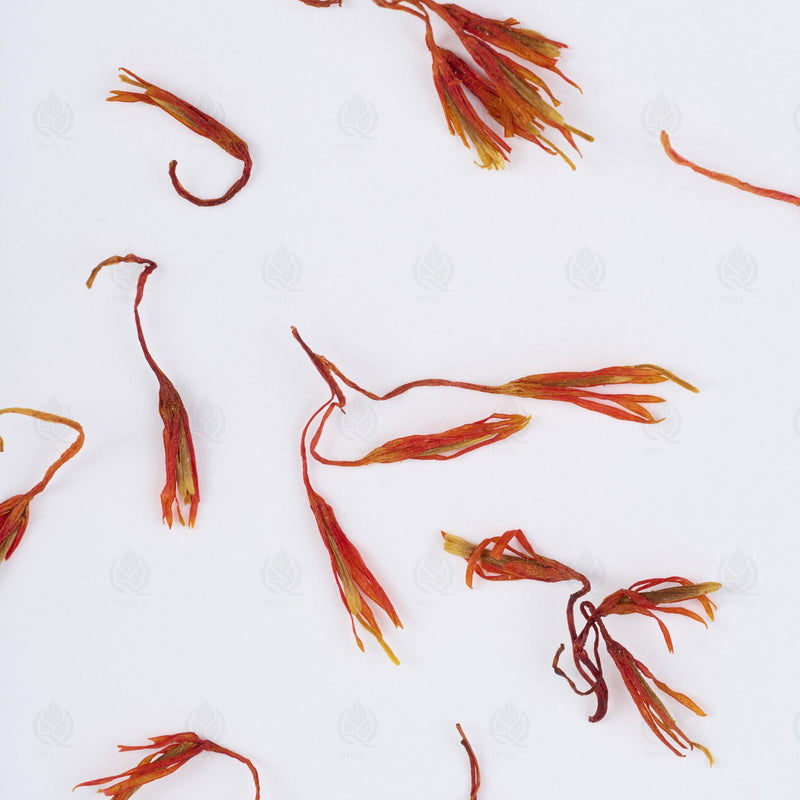

Safflower flowers
红花 · Hong Hua
7,50 €


Turmeric
姜黄 · Jiang Huang
4,17 €