

Amomum fruits


Cardamom-like Amomum Fruit
砂仁Sha Ren·Fruits d’Amome
Amomi Fructus
- Specialist suppliers based in France
- Dispatched within 24/48h, packed to order
- Kept away from light and moisture

Amome 縮砂蔤
Amomum villosum
Wu Qijun, Zhiwu mingshi tukao, 1848
According to the classical texts
化湿行气 温中止呕 安胎
Pinyin
Hua Shi Xing Qi · Wen Zhong Zhi Ou · An Tai
Overview
The spherical capsules of Amomum villosum, a plant of the ginger family grown in the tropical regions of Yunnan and Fujian.
Harvested at full maturity, when the reddish-brown capsules hold black, glossy, highly aromatic seeds, they are dried whole and then traditionally used whole or hulled.
A cousin of Indian culinary cardamom (Elettaria cardamomum) but a distinct species.
Its warm, camphorous scent and its pungent-bitter savour are immediately recognisable, a spice prized in the warming cookery of Asia.
Traditional uses
A very mild aromatic herb for moving the Qi through the median sphere and transforming settled Dampness gently.
Traditionally used for constitutions where Dampness blocks transformation (Yun Hua) and weighs on the median sphere.
Preparation and traditional-use quantity
- Very short decoction: 3 to 6 g, to be lightly crushed and added at the very end of cooking (5 minutes) so the essential oils are kept
- Whole form within a blend: to be wrapped in a muslin bag (Bao Jian) to make straining easier
- Supplementing cooking: added to simmered broths, meat marinades and finely made five-spice
Precautions
To be avoided in cases of deficient with empty heat or of settled heat. Otherwise a mild herb, one of the few movers of Qi compatible with the time of expecting a child should the need arise (a practitioner’s advice).
In the same family

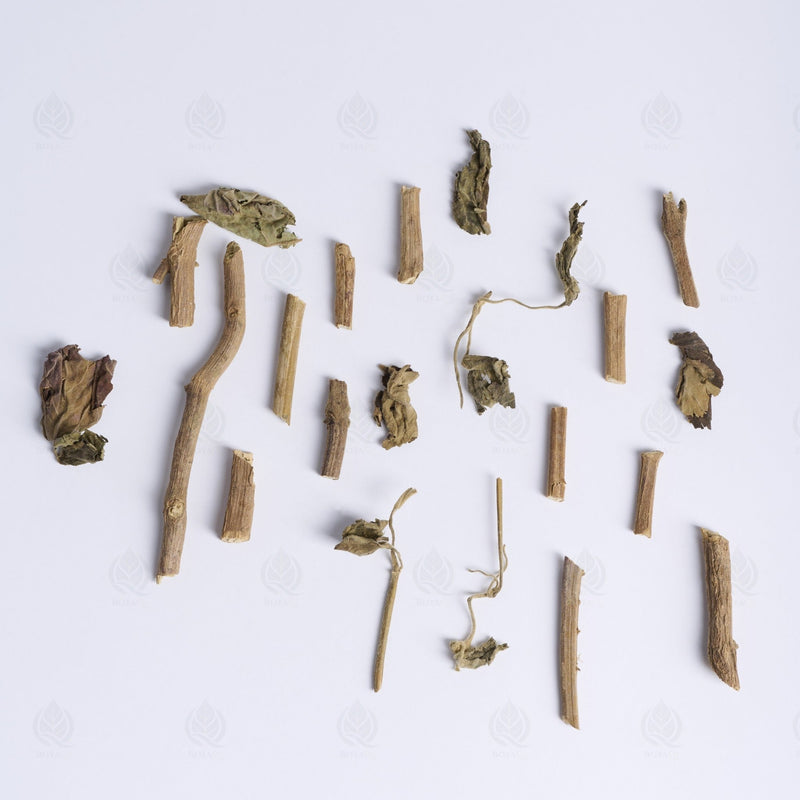

Agastache
藿香 · Huo Xiang
5,67 €