

Loquat leaves (Japanese medlar)


Loquat Leaf
枇杷叶Pi Pa Ye·Feuilles de Néflier du Japon (Bibacier)
Eriobotryae Folium
- Specialist suppliers based in France
- Dispatched within 24/48h, packed to order
- Kept away from light and moisture

Néflier du Japon 枇杷
Eriobotrya japonica
Wu Qijun, Zhiwu mingshi tukao, 1848
According to the classical texts
清肺止咳 降逆止呕
Pinyin
Qing Fei Zhi Ke · Jiang Ni Zhi Ou
Overview
The large leathery leaves of the Japanese medlar (Eriobotrya japonica), gathered all year round, those of autumn being preferred.
The underside of the leaves carries an abundant reddish-brown down which must traditionally be removed by brushing before use: its presence is held to be irritating to the throat.
Once brushed, the leaves are sometimes prepared with honey (Mi Zhi Pi Pa Ye), a preparation the tradition reads as more moistening.
A plant of the Asian garden, whose fruit (the Japanese medlar, or loquat) is also much appreciated.
Traditional uses
The reference herb for carrying down the rebellious Qi of the Phase and settling the breath disturbed by heat.
Traditionally used for constitutions where heat settles into the sphere of the breath with irritation and a dry disturbance of the breath, or to quiet the upward surges of Qi from the median sphere (surges of Qi through heat).
Preparation and traditional-use quantity
- Decoction: 5 to 10 g, to be brushed and wrapped in a muslin bag (Bao Jian), as the hairs on the underside irritate the throat
- Honey-prepared form (Mi Zhi Pi Pa Ye): the traditional version, which makes the moistening turn more pronounced and softens the Cool nature
- Pi Pa Gao: the traditional Cantonese syrup made from Pi Pa Ye leaves and honey
Precautions
To be avoided in cases of deficient Yang with deep cold and cold, disturbed breath (its cool nature can add to the imbalance).
Always brush the leaves or use a sachet, to avoid irritation from the hairs.
In the same family


Sterculia seed
胖大海 · Pang Da Hai
2,92 €

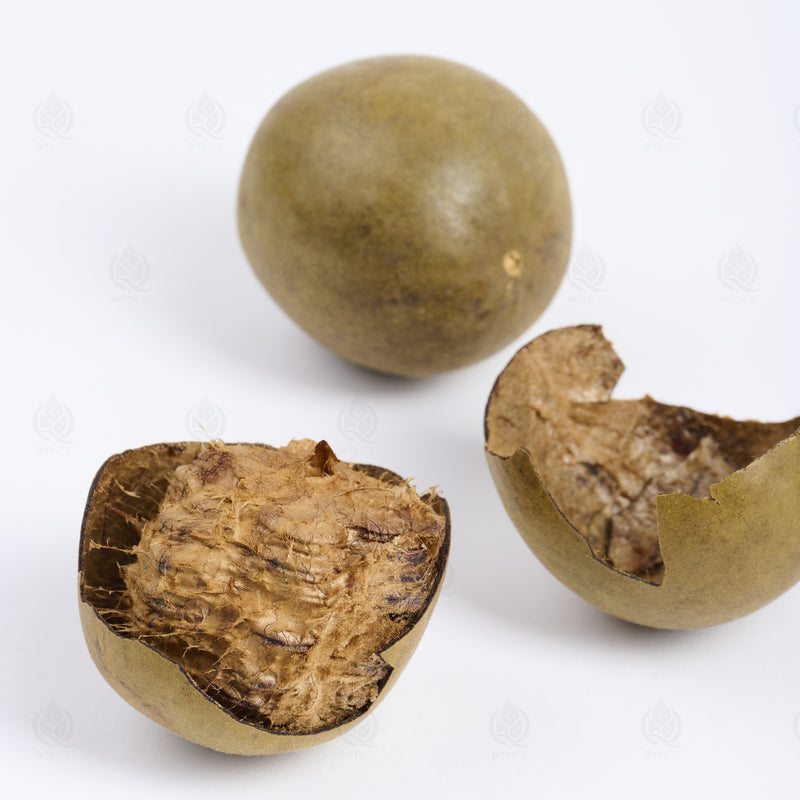
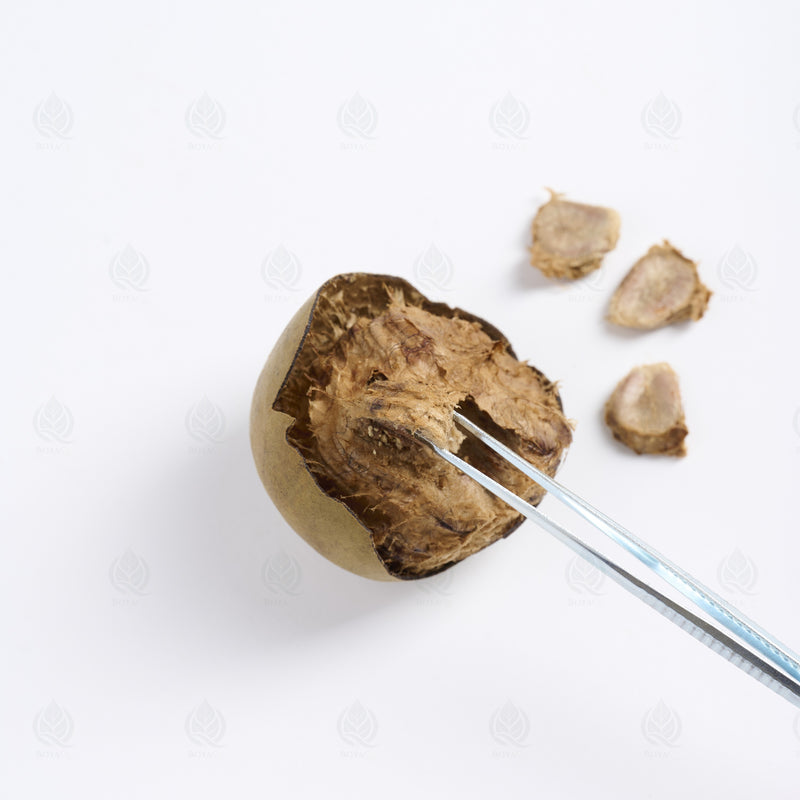

Monk fruit
罗汉果 · Luo Han Guo
From 4,00 €


Trichosanthes rind
瓜蒌皮 · Gua Lou Pi
5,83 €